Friday, March 1, 2024
Zenith Man: Death, Love, and Redemption in a Georgia Courtroom, by McCracken Poston
Saturday, January 6, 2024
Fear is Just a Word: A Missing Daughter, a Violent Cartel, and a Mother's Quest for Vengeance, by Azam Ahmed
"How can they just let something like this happen? ... What is the government doing? Why aren't they stopping this?"
Thursday, January 12, 2023
Fifty Forgotten Books, by R.B. Russell
"intended to be a personal recommendation of often overlooked and unloved novels, short story collections, poetry and non-fiction."
"not just to discuss the books, but to explain what they have meant to me over time, thus forming an oblique, partial memoir of my life."
He is overwhelmingly successful on both fronts.
![]() |
the true cover underneath the burnt orange dustjacket |
Saturday, December 17, 2022
In the Mouth of the Wolf: A Murder, A Cover-Up, and the True Cost of Silencing the Press, by Katherine Corcoran
"A society without truth is a scary place to live."
![]() |
Regina Martinez, from Forbidden Stories |
Monday, August 29, 2022
We Carry Their Bones: The Search for Justice at the Dozier School For Boys, by Erin Kimmerle
"They was throwaways."
"The stories raised questions about a purported cemetery on the school's property, and the reporter had hit a dead end. He had found the families of boys who died in custody and were buried at the school, families that had never found peace, for they'd never been given the opportunity to properly mourn. No one could point to the location of the graves where their brothers and uncles were buried. No state official had stepped up to find those burials."
"no evidence to suggest that the School or its staff made any attempts to conceal and/or contributed to the deaths of these individuals"
and documented the number of burials as thirty-one, which just happened to correspond to the number of crosses (made out of pipes) placed there in the 1990s. Kimmerle's use of ground-penetrating radar suggested at least fifty burials in the area of Boot Hill, and the historical record speaks for itself as far as covering up crimes.
Wednesday, July 13, 2022
No Surrender: My Thirty-Year War by Hiroo Onoda
"don't think too much about it, because I may well show up again after a few years."
Given what happened with this man, that turned out to be an understatement. Onoda was assigned to Lubang Island, to "lead the Lubang Garrison in guerrilla warfare." The objective: "to hamper the enemy attack on Luzon." Onoda was directed to destroy both the airfield and the pier at the island's harbor; he was further tasked with destroying enemy planes and killing the crews "should the enemy land" there. His final orders, however, were that he was "forbidden" to kill himself:
" It may take three years, it may take five, but whatever happens we'll come back for you. Until then, so long as you have one soldier, you are to continue to lead him. You may have to live on coconuts. If that's the case, live on coconuts! Under no circumstances are you to give up your life voluntarily."
![]() |
| from Semantic Scholar |
![]() |
Onoda leaving the jungle with former commanding officer Tanaguchi after he'd officially relieved him of duty. From Rare Historical Photos |
Friday, April 22, 2022
Robert Aickman: An Attempted Biography, by R.B. Russell
"a disinterested group of enthusiasts (but not fanatics) could do much to better the state of the canals,"
"had been neglected for many years, a large proportion of them owned by railway companies that initially brought with them the aim of removing objection to their proposed new railway lines,"
Friday, January 28, 2022
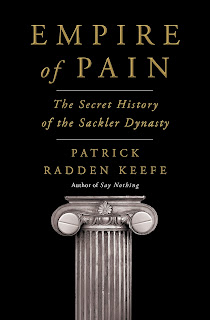
Empire of Pain: The Secret History of the Sackler Family, by Patrick Radden Keefe
"was astonished to discover that the family that presided over the company that made OxyContin was a prominent philanthropic dynasty with what appeared to be an unimpeachable reputation."
"story about ambition, philanthropy, crime and impunity, the corruption of institutions, power, and greed."
Isaac Sackler always hoped that his sons would "leave their mark on the world," which they did, but my guess would be probably not in the way Isaac had intended.
The three Sackler sons (Arthur, Raymond and Mortimer) went on to become doctors, the latter two joining Arthur working in a state psychiatric facility in New Jersey, Creedmoor Hospital. In 1942, while still working at Creedmoor, Arthur accepted a position with the William Douglas McAdams agency which specialized in pharmaceutical advertising, where the focus became one of "how do you sell a pill?" Sackler was savvy enough to know that the real money would come from advertising directly to physicians rather than consumers, and beginning with a Pfizer product called Terramycin, he laid the foundations for future pharmaceutical marketing. Without going into detail, Sackler's strategies included marketing to "the prescribers" in medical journals, hiring a force of energetic sales reps, convincing prominent doctors to get on board with endorsements, having drug companies cite certain scientific studies (often underwritten by the companies themselves) that claimed that the new drug worked well and that it was safe. What Sackler had created was a "synergy between medicine and commerce," and the strategies worked: while the product itself wasn't particularly "groundbreaking," it was highly successful since "it had been marketed in a way that no drug had ever been." Not only had "Arthur invented the wheel," but he'd also laid the foundation for the future of pharmaceutical sales, including Valium, which more than cemented the Sackler family fortune. He also bought a "small pharmaceutical company" in 1952, by the name of Purdue Frederick, the running of which would be left in the hands of his brothers.
"study of impunity among the super elite and a relentless investigation of the naked greed and indifference to human suffering that built one of the world's great fortunes."
Saturday, January 8, 2022
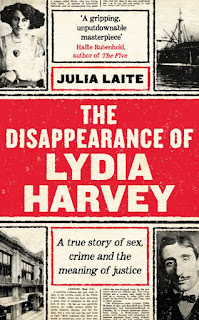
The Disappearance of Lydia Harvey: A True Story of Sex, Crime, and the Meaning of Justice, by Julia Laite
"She was no one. Who she was, what she wanted, what happened afterwards; none of this mattered. She joined a legion of missing girls, whose brief appearances in newspapers and books remained uncomplicated by their past experiences of poverty, abuse or their exploitation in other kinds of work."
"condemned to a short life of misery, disease and degradation; they 'vanished forever beneath the slime of the underworld' and remained 'literally nameless and unknown,' "
"fashioned by crusading journalists and anti-vice campaigners and taken up by a society that longed for young women to remain in their traditional place, while exploiting them for their cheap and flexible labor."
Unfortunately, "the language of white slavery" didn't cover the exploitation of "black, Asian and indigenous" victims; the actual "white slavers" were also "profoundly racialised." Often women such as Lydia were somewhat idealized, while at the same time there seemed to be far less attention paid to who was responsible. There is also another, more complex matter that muddies the water: often, as in the case of one of Lydia's traffickers, Veronique Caravelli, sometimes women were both sex workers and traffickers, which seems to upset the typical understanding of victim and victimizer -- women who didn't quite fit the accepted mold of victims were most often characterized as criminals. Lydia's story played out at a time of a growing globalization of sex work, the trafficking existing on an international scale that ultimately required police forces around the world not only to be in communication with each other, but also to "establish a central authority in each country" to coordinate both national and international anti-trafficking efforts, which continued to victimize women. Obviously this is just a sort of nutshell description, and there is much, much more that I haven't even touched upon -- the role of the press, the role of social work, and so on, leaving it for the reader to discover.
At the outset the author reveals that there are "thousands of missing pieces to this puzzle," either lost, destroyed, or never made part of any historical record. Acknowledging that she had to weave "threads of imagination" into the information she discovered, she also notes that she has "followed careful rules" in doing so -- historical evidence exists for every detail offered in this story. Considering what she didn't have, she's done an excellent job here; not only is this book well researched, but the different perspectives that come to interconnect offer a more in-depth understanding of the individuals who made up part of Lydia's story as well as (quoting the dustjacket blurb) "the forces that shaped the twentieth century." I absolutely love reading history when it's written like it is here, in which an obscure figure from the past is given a voice and a life while all the while a clear picture of the world surrounding her takes shape. It is also amazing how much of this story continues to resonate in our own time, which I picked up on very early in the reading, but it is an idea runs throughout the book.
Very nicely done and very, very highly recommended.
Saturday, December 11, 2021
Pan: The Great God's Modern Return, by Paul Robichaud
"Surveying Pan's role in mythology, art, literature, music, spirituality and popular culture ... shows how portrayals of the god reveal shifting anxiety about our own animality and our relationship to the natural world, whether this is understood as the wilderness beyond civilization or the cosmos as a whole. "
He begins with "Mythic Pan," exploring Pan's origins in the Arcadia region of Greece long before any written records appeared. Earliest representations of Pan consisted of bronze statues revealing the great god as an object of veneration by shepherds in the area. From there "the cult of Pan" made its way from Arcadia spreading across Greece, inspiring not only myth, but also poetry in the "pastoral" form as captured by Theocritus and Virgil (whose work, in turn, would also inspire others later through the centuries).
These "classical visions of Pan" ended when Constantine decreed that Christianity would become the Roman Empire's official religion, sending paganism into a "kind of half-life" until Pan and other pagan gods "disappeared from public view" up to the time of the Renaissance as discussed in "Medieval and Early Modern Pan." He reappears in different forms during this time, usually allegorically, so as to avoid controversy with the church. Signorelli's The School of Pan (1490) is just one example; as the author reveals, art historian Michael Levey has described the figures in the painting as "banished creatures of mythology, who had always existed and who have now crept back into the welcoming Renaissance air."
| from Pinterest |
"valued wild nature, passion and imagination -- all of which were conducive to a rebirth of enthusiasm for the god, as was a revival of interest in all things Greek, including the irrational mysteries of Greek religion"
taking his readers into the late nineteenth century before moving onto the twentieth. Noteworthy among the many and various works discussed in this section, the author offers queer representations of Pan in literature, including Forrest Reid's novel The Garden God from 1905 (which is now sitting on my shelf ready to be read thanks to a reprint by Valancourt Books) and E.F. Benson's short story "The Man Who Went Too Far," a chilling story which I recently read in John Miller's collection Weird Woods, published by the British Library.
Two more chapters bring us to the end. First, "Pan as Occult Power" first examines Pan's more esoteric appearances in the work of Eliphas Levi; it's then on to fiction where he examines Machen's Great God Pan in some depth as well as the writings of Aleister Crowley, Victor Neuberg, Algernon Blackwood, and Dion Fortune before taking on Pan's association with modern witchcraft and the figure of the Horned God. Chapter six then delves into "Contemporary Pan" which for me held a number of surprising connections to ponder.
Robichaud, as he explains at the beginning, has no assumptions that readers of this book might have "any prior knowledge of the material explored here," and he has written this volume in a highly-approachable fashion making it beyond reader friendly. I have barely skimmed the surface in this post, but trust me -- if anyone wants to know anything at all about the Great God Pan, it's very likely found here in this wide-ranging exploration of the goat-footed god. Beware though -- I came up with a list of twenty-five books I wanted to read from the author's source material.
Most definitely and very highly recommended; an excellent book that will have a place of honor on my shelves.
Saturday, November 13, 2021
Truffle Hound: On the Trail of the World's Most Seductive Scent, With Dreamers, Schemers and Some Extraordinary Dogs, by Rowan Jacobsen
"two have starring roles: Tuber magnatum, Italy's celebrated white truffle, which is often called the Alba; and Tuber melanosporum, the queen of black truffles.."
Describing his first olfactory encounter with the white truffle , Jacobsen notes that
"It was hardly a food scent at all. It was more like catching a glimpse of a satyr prancing across the dining room floor while playing its flute and flashing its hindquarters at you. You think, What the hell was that? And then you think, I have to know. "
![]() |
| In Hungary: Grand Master of the Saint Ladislaus Order of Truffle Knights, Zoltan Bratek (from my copy) |
Sunday, August 15, 2021
My Dark Places, by James Ellroy
"Dead women owned me."