Friday, January 28, 2022

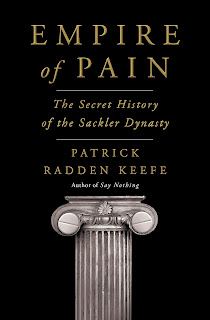
Empire of Pain: The Secret History of the Sackler Family, by Patrick Radden Keefe


9780385545686
Doubleday, 2021
535 pp

hardcover


In the afterword of this book, the author notes that he'd started working on this project in 2016, having come to it "indirectly."  While researching the Mexican drug cartels ("not just as criminal organizations but as businesses"),  his research had led him to the "new emphasis, among the cartels, on heroin."  From there, Keefe was led to OxyContin, and to reading Barry Meier's Pain Killer and Dreamland (an excellent book, by the way) by Sam Quinones as well as articles published in the Los Angeles Times.  He notes that he 
"was astonished to discover that the family that presided over the company that made OxyContin was a prominent philanthropic dynasty with what appeared to be an unimpeachable reputation."   
In an interview at Esquire in October of last year, the author explains what was behind the writing of this book, saying that he didn't want to write a book "in which the Sacklers felt like cyphers, in which they felt very remote."   Since they would neither speak to or communicate with him,  writing a book would feel "ineffective -- as though you were seeing them through a telescope, very, very distantly." But then litigation against the company and later the family resulted in  a "huge body of documentation ... getting released in these lawsuits, including lots and lots of private emails" that offered Keefe a way to tell a "vivid and engaging" story, one in which "you feel like you really come to understand these people."   An engaging revelation of the lengths this uber-wealthy family would go to to avoid any accountability, Empire of Pain  is also a story of a family that somehow failed to pass on any sort of empathy through the generations, valuing their "good name" and their ongoing wealth above all other considerations.   

And what a story it is indeed.  In 1904 Isaac Sackler arrived in America from Galicia, and along with his three brothers, opened up a small grocery store in Williamsburg, New York.  He did well enough to invest in real estate, but during the Depression when his fortunes started to wane,  he reminded his three sons that he had "bestowed upon them something more valuable than money... a good name."  As the sons' wealth began to grow, they delighted in seeing that "good name" adorn many a philanthropic enterprise, all the while keeping silent about where their money originated. In Empire of Pain, the author examines the Sackler dynasty, revealing a 
"story about ambition, philanthropy, crime and impunity, the corruption of institutions, power, and greed."

Isaac Sackler always hoped that his sons would "leave their mark on the world,"  which  they did, but my guess would be probably not in the way Isaac had intended.  

The three Sackler sons (Arthur, Raymond and Mortimer) went on to become doctors, the latter two joining Arthur  working in a state psychiatric facility in New Jersey, Creedmoor Hospital.  In 1942, while still working at Creedmoor, Arthur accepted a position with the William Douglas McAdams agency which specialized in pharmaceutical advertising, where the focus became one of "how do you sell a pill?"  Sackler was savvy enough to know that the real money would come from advertising directly to physicians rather than consumers, and beginning with a Pfizer product called Terramycin, he laid the foundations for future pharmaceutical marketing.  Without going into detail, Sackler's strategies included marketing to "the prescribers" in medical journals,  hiring a force of energetic sales reps, convincing prominent doctors to get on board with endorsements, having drug companies cite certain scientific studies (often underwritten by the companies themselves) that claimed that the new drug worked well and that it was safe.   What Sackler had created was a "synergy between medicine and commerce,"  and the strategies worked:  while the product itself wasn't particularly "groundbreaking," it was highly successful since "it had been marketed in a way that no drug had ever been."  Not only had "Arthur invented the wheel," but he'd also laid the foundation for the future of pharmaceutical sales, including Valium, which more than cemented the Sackler family fortune.  He also bought a "small pharmaceutical company" in 1952, by the name of Purdue Frederick, the running of which would be left in the hands of his brothers.  

Flash forward in time: Richard Sackler, son of Raymond, got his medical degree  and in 1971 joined Purdue Frederick as assistant to the president (his dad).   When MSContin came along, Purdue started manufacturing and selling it in 1984, generating hundreds of millions in sales, "dwarfing anything that the company had sold in the past."  By 1990 though, Purdue was set to "lose the monopoly on its flagship painkiller" due to patent issues, so they needed a "successor." Enter OxyContin, in 1996.   The word at Purdue Pharma (formed in 1991)  was that this drug was so good that it would "sell itself" but Purdue was taking no chances.  The Sacklers followed Arthur's template in influencing government agencies like the FDA, co-opting physicians, completely downplaying the addictive qualities of the drug, faking reports, offering "capless" incentives to the sales reps, financing organizations advocating freedom from pain as well as pain research, and the list goes on.   OxyContin became "the one to start with and the one to stay with."  That turned out to be true: Purdue created a huge market for OxyContin, which in turn led doctors to prescribe it and to people becoming dependent on it.    It also launched a major public health crisis -- by 2010, "millions of people had become addicted to OxyContin and other opioids," and America was "in the grip of a full-blown opioid epidemic."   Purdue's answer:  it's not the drug, it's the people abusing the drug. 

 In the long run, as Keefe so skillfully reveals, the Sacklers did anything and everything necessary not only to deny and refute the claims of addiction, but also to preserve their "good name."  

There is much more to this book than I can describe here, but as the dustjacket blurb notes,  Empire of Pain is "a portrait of excesses,"  as well as a 
"study of impunity among the super elite and a relentless investigation of the naked greed and indifference to human suffering that built one of the world's great fortunes." 
I don't know how anyone can read Empire of Pain and walk away unaffected.  What struck me the most was the family's sheer lack of empathy, the lack of any sort of accountability, and the ease with which they managed to co-opt the institutions that are supposed to protect the public, including the FDA and the Department of Justice.   The icing on the cake comes in watching the HBO documentary "Crime of the Century," which not only shows certain members of our government allowing all of this to happen, but also reveals how much Sackler money they'd received in campaign contributions.  But read this book first. 

Highly, highly, highly recommended.  


Saturday, January 8, 2022

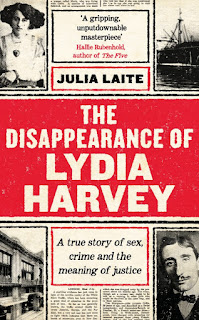
The Disappearance of Lydia Harvey: A True Story of Sex, Crime, and the Meaning of Justice, by Julia Laite


9781788164429
Profile Books, 2021
410 pp

hardcover

Before I launch into my thoughts here, I absolutely have to offer my grateful thanks to the unknown but very much appreciated person who sent me this book, whoever that person may be.  


 The Disappearance of Lydia Harvey is a well-constructed and thoroughly engaging work of history which might best be described as narrative nonfiction, meaning that there is not only a story to be told here, but a central plot, if you will, with a young woman by the name of Lydia Harvey at its center. We learn in the first sentence of this book that in January, 1910, "just a few months shy of her seventeenth birthday, Lydia Harvey disappeared."   That was her physical disappearance, but she also "disappeared again and again" in the stories told about her by others:
"She was no one. Who she was, what she wanted, what happened afterwards; none of this mattered.  She joined a legion of missing girls, whose brief appearances in newspapers and books remained uncomplicated by their past experiences of poverty, abuse or their exploitation in other kinds of work."
While many of these women had stories told about them which ended, 
"condemned to a short life of misery, disease and degradation; they 'vanished forever beneath the slime of the underworld' and remained 'literally nameless and unknown,' "
Lydia, as we are told, "refused this story;"  and did not, as the dustjacket blurb reveals, "vanish forever into the slime of the underworld" despite others' expectations.   

Lydia Harvey was sixteen years old in 1910 when she boarded a ship for Buenos Aires, leaving her family, her friends  and her job behind.  She had earlier been taken into a "respectable" home in the city as a domestic, but she worked long hours for very little money so when the opportunity arose to work in a photography studio, she took it.   It wasn't long until she met "a beautiful woman and a handsome man" who offered her "nice dresses" and would "help her to travel;" her job would be "seeing gentlemen."   Whether or not Lydia realized what she was in for is unknown, but as the author states, this girl, alone, sixteen, "work-weary and starry eyed" decided to take a risk, explaining her absence via letter to her mother saying that she'd gone on to become a "nursemaid for a respectable couple" in London.   In Buenos Aires she found herself working as a prostitute, constantly reminded of how indebted she was to  the couple who had brought her there, but things didn't go as planned, so  they all  traveled to London where eventually Lydia was arrested.  Her story might have ended there, but  in a Soho police station she "gave a witness statement that would form the key piece of testimony that saw her traffickers brought to some semblance of justice," and then, unlike so many young women in her situation, actually testified in court.

Author Julia Laite had first encountered Lydia and her statement while  researching her first book Common Prostitutes and Ordinary Citizens, published in 2011, and according to this interview in the New Zealand Herald ,  she couldn't get Lydia out of her head, "wondering what had happened before and what happened after."  In writing this book, not only does the author answer this question, but she focuses a lens on several people whose lives became interwoven with Lydia's, offering Lydia's story to emerge through their eyes as well.  She begins with Lydia's early life, moving her forward in time to being trafficked and to her encounter with the police in London; she then takes up the story from the perspective of the police, followed by that of the media, a rescue worker to whom Lydia was sent after being arrested,  and then finally on to the couple who trafficked her.  Yet this is neither a simple  biography or history by any means; there is a wider story at work here involving, among other things, rapidly-changing women's roles, a world becoming much more interconnected,  an increase in mobility among women, especially among the lower-middle and working classes, all of which sparked societal anxieties encapsulated by the "white-slavery panic" 
"fashioned by crusading journalists and anti-vice campaigners and taken up by a society that longed for young women to remain in their traditional place, while exploiting them for their cheap and flexible labor." 

 Unfortunately, "the language of white slavery" didn't cover the exploitation of  "black, Asian and indigenous" victims;  the actual "white slavers" were also "profoundly racialised."   Often women such as Lydia were somewhat idealized, while at the same time there seemed to be far less attention paid to who was responsible.  There is also another, more complex matter that muddies the water: often, as in the case of one of Lydia's traffickers, Veronique Caravelli, sometimes women were both sex workers and traffickers, which seems to upset the typical understanding of victim and victimizer -- women who didn't quite fit the accepted mold of victims were most often characterized as criminals.   Lydia's story played out at a time of a growing  globalization of sex work,  the trafficking existing on an international scale that  ultimately required police forces around the world not only to be in communication with each other, but also to "establish a central authority in each country" to coordinate both national and international anti-trafficking efforts, which continued to victimize women. Obviously this is just a sort of nutshell description, and there is much, much more that I haven't even touched upon -- the role of the press, the role of social work, and so on, leaving it for the reader to discover.  

At  the outset the author reveals that there are "thousands of missing pieces to this puzzle," either lost, destroyed, or never made part of any historical record.  Acknowledging that she had to weave "threads of imagination"  into the information she discovered, she also notes that she has "followed careful rules" in doing so -- historical evidence exists for every detail offered in this story.    Considering what she didn't have, she's done an excellent job here; not only is this book well researched, but the different perspectives that come to interconnect offer a more in-depth understanding of the individuals who made up part of Lydia's story  as well as (quoting the dustjacket blurb) "the forces that shaped the twentieth century."    I absolutely love reading history when it's written like it is here, in which an obscure figure from the past is given a voice and a life while all the while a clear picture of the world surrounding her takes shape.  It is also amazing how much of this story continues to resonate in our own time, which I picked up on very early in the reading, but it is an idea runs throughout the book.   

Very nicely done and very, very highly recommended.  


Saturday, December 11, 2021

Pan: The Great God's Modern Return, by Paul Robichaud


9781789144765
Reaktion Books, 2021
344 pp

hardcover

I am a huge fan of Arthur Machen's novella The Great God Pan (which I've recently reread),  and I've been saying for some time now that some enterprising person would be doing readers like me a huge favor by collecting and compiling every story ever written about Pan and publishing them all together in book form.  Since that's unlikely to be in the works for the near future, spending more time reading about the great god seemed to me to be a good idea, so I was beyond excited when I first heard about the publication of this book. It is one I've been looking forward to for a very long time, and without hesitation I can say that I was not at all disappointed. Historian Paul Robichaud has written this volume for readers "interested in learning more about the goat-footed god and how he has been imagined through the centuries."  That would be me. For sure.

"Through the centuries" is not an understatement in this case.  Robichaud traces the various ways that Pan has been envisioned from antiquity up to our own time, using "individual texts, works of art and musical compositions," introducing them and "relating them where possible to the larger tradition of which they form a part."     As he notes, 
"Surveying Pan's role in mythology, art, literature, music, spirituality and popular culture ... shows how portrayals of the god reveal shifting anxiety about our own animality and our relationship to the natural world, whether this is understood as the wilderness beyond civilization or the cosmos as a whole. "

 He begins with "Mythic Pan," exploring Pan's origins in the Arcadia region of Greece long before any written records appeared.  Earliest representations of Pan consisted of bronze statues revealing the great god as an object of veneration by shepherds in the area.  From there "the cult of Pan" made its way from Arcadia spreading across Greece, inspiring not only myth, but also poetry in the "pastoral" form as captured by Theocritus and Virgil (whose work, in turn, would also inspire others later through the centuries).   

These "classical visions of Pan" ended when Constantine decreed that Christianity would become the Roman Empire's official religion, sending paganism into a "kind of half-life" until Pan and other pagan gods "disappeared from public view" up to the time of the Renaissance as discussed in "Medieval and Early Modern Pan."  He reappears in different forms during this time, usually allegorically, so as to avoid controversy with the church.  Signorelli's The School of Pan (1490) is just one example; as the author reveals,  art historian Michael Levey has described the figures in the painting as "banished creatures of mythology, who had always existed and who have now crept back into the welcoming Renaissance air." 


from Pinterest

A few of Pan's appearances in literature come by way of Rabelais, Francis Bacon, Spenser and Milton; in popular culture he becomes the figure of  Robin Good-fellow and even stands as symbol for James II, who was banished in 1688, serving as a code for Jacobites when it was dangerous to be known as loyal to the Stuarts.  

I won't go through each and every chapter in any depth, but  after the Renaissance, Pan re-emerges during the late eighteenth century and the Romantic period, which 

"valued wild nature, passion and imagination -- all of which were conducive to a rebirth of enthusiasm for the god, as was a revival of interest in all things Greek, including the irrational mysteries of Greek religion" 

  taking his readers into the late nineteenth century before moving onto the twentieth.   Noteworthy among the many and various works discussed in this section, the author offers queer representations of Pan in literature, including Forrest Reid's novel The Garden God from 1905 (which is now sitting on my shelf ready to be read thanks to a reprint by Valancourt Books) and E.F. Benson's short story "The Man Who Went Too Far," a chilling story which I recently read in John Miller's collection Weird Woods, published by the British Library.  

Two more chapters bring us to the end.  First, "Pan as Occult Power" first examines Pan's more esoteric appearances in the work of Eliphas Levi; it's then on to fiction where he examines Machen's Great God Pan in some depth as well as the writings of Aleister Crowley, Victor Neuberg, Algernon Blackwood, and Dion Fortune before taking on Pan's association with modern witchcraft and the figure of the Horned God.    Chapter six then delves into "Contemporary Pan" which for me held a number of surprising connections to ponder.  

Robichaud, as he explains at the beginning, has no assumptions that readers of this book might have "any prior knowledge of the material explored here," and he has written this volume in a highly-approachable fashion making it beyond reader friendly.   I have barely skimmed the surface in this post, but trust me -- if anyone wants to know anything at all about the Great God Pan, it's very likely found here in this wide-ranging exploration of the goat-footed god.   Beware though -- I came up with a list of twenty-five books I wanted to read from the author's source material.  

Most definitely and very highly recommended; an excellent book that will have a place of honor on my shelves.  


Saturday, November 13, 2021

Truffle Hound: On the Trail of the World's Most Seductive Scent, With Dreamers, Schemers and Some Extraordinary Dogs, by Rowan Jacobsen


9781834474194
Bloomsbury, 2021
283 pp

hardcover (my copy from the publisher, thanks!)


Just prior to the Covid outbreak of 2020, a new restaurant opened nearby and everyone I know who went there raved about the truffle fries.  I asked one of my friends if she knew that there was nothing truffle about the fries, and she looked at me like I was out of my mind and told me about the delicious and rich truffle oil that gives them their flavor.    So now that I've finished this book, I'll be handing it over to her so that she can see for herself that her beloved truffles frites are covered in olive oil containing 2,4-dithiapentane, a synthetic chemical that offers up a "heavy-handed impression of truffleness."  Anthony Bourdain once said about truffle oil that it was "about as edible as Astroglide, and made from the same stuff."  This book, however, isn't about dispelling myths about the stuff poured over french fries to push them into the double-digit dollar zone -- it is an examination of the "dreamers, schemers, and sensualists" who in the presence of the fungi itself become "quivering puddles."  Of the real stuff, there are a variety out there -- chef and author Rowan Jacobsen mentions at the outset that "about a dozen species play prominent roles in this tale" -- of those, 
"two have starring roles: Tuber magnatum, Italy's celebrated white truffle, which is often called the Alba; and Tuber melanosporum, the queen of black truffles.."

Describing his first olfactory encounter with the white truffle , Jacobsen notes that 

"It was hardly a food scent at all.  It was more like catching a glimpse of a satyr prancing across the dining room floor while playing its flute and flashing its hindquarters at you. You think, What the hell was that? And then you think, I have to know. "

I not only love that description but I also understand  -- I've never had the pleasure to have tried the white variety but the black, well, there's this little Italian deli that carries them and they have more than once (very sparingly) graced my papardelle in shaved form.   Anyway, after that first experience with the white truffle's heavenly scent,  the author went looking to discover what he could about these prized fungi, and  found himself on a "quest" to discover what it is about truffles that has the power to turn people into the above-mentioned "quivering puddles."  Traveling throughout Europe, the UK, Canada, and various places here in the US, Jacobsen spent time with truffle hunters, their specially-trained dogs, hopeful truffle farmers and entrepreneurs looking toward the future, truffle sellers and scientists to learn all he could about these prized fungi, of which the white variety is, as he says, "the world's most expensive food."   The more he becomes involved in his quest, the more he finds himself "starting to think of truffles as the street artists of the forest, splashing smells across an airy canvas, blowing the minds of passersby." 


In Hungary:  Grand Master of the Saint Ladislaus Order of Truffle Knights, Zoltan Bratek (from my copy)


This is my first book by Jacobsen; I love his casual yet knowledgeable style of writing enough that on the strength of this one I just bought his A Geography of Oysters even though I despise them.  Even if you don't like food writing (or truffles for that matter),  there is much to enjoy in Truffle Hound, especially the stories of the people Jacobsen meets and of course, the awesome dogs who are part and parcel of the experience.  This is a good book, and I can most certainly recommend it.  


*******
With apologies to Nicole at Bloomsbury for taking forever to finish this book, I offer my sincere thanks for the lovely, finished copy.  


Sunday, August 15, 2021

My Dark Places, by James Ellroy

 "Dead women owned me." 


9780679762058
Vintage, 1997
424 pp

paperback

Last year I read Ellroy's LA Quartet, the opening novel of which is The Black Dahlia In that book, as the author noted in his afterword, a "personal story attends the Black Dahlia," inextricably linking him to "two women savaged eleven years apart."   One of these women was his mother, Geneva (Jean) Hilliker, who was killed in 1958, her murderer unknown and her case never solved.  The other, of course, was the real-life Black Dahlia herself, Elizabeth Short, whose story Ellroy had read as a boy in Jack Webb's The Badge "a hundred times" and who not only became his "obsession," but also a "symbiotic stand-in" for his mother. My Dark Places tells that "personal story," which began when the author was ten and arrived home to discover that his mother was dead; it also explores his own unique relationship to her memory and how it changed over time.   It was her murder that shaped who he ultimately became; here he lays his demons bare for all to see.   Completely misquoting Bette Davis in All About Eve, fasten your seatbelts -- you're in for a bumpy ride.   

The body of Jean Hilliker Ellroy was found on Sunday, June 22, 1958 in a small strip of ivy at King's Row and Tyler Avenue in El Monte, California.  The first part of the book details the crime from that point,  using a third-person point of view to tell the story, recreated from the records of the original investigation.   After the victim had been discovered, her car had been found behind a local bar where she'd spent time with two other people, a blonde woman with a ponytail and a man who came to be known as "the Swarthy Man," both unidentified.  From there her whereabouts were traced (sans the blonde) to a local drive-in, where a carhop put her with the Swarthy Man in his car twice that night.  After that, despite tracking any and every lead they had and interviewing a number of witnesses and possible suspects,  law enforcement lost their trail and the case went cold, or as Ellroy puts it, "moved into limbo."   In Part Two, Ellroy delves into his past, detailing his somewhat complicated relationship with his mother and after her death, his life with his father.  As a kid, he knew his mother drank and brought men home, and even before her death was told by his father in no uncertain terms that she was a whore.  After she died, he went to live with his father where he was left largely unsupervised and subject to his father's rants on race and women.  Ellroy's life began to spiral downward during this time -- school left him feeling like he didn't fit in, he started using drugs, broke into houses, shoplifted, stalked girls and did some pretty horrific things for attention; as he got older and his dad's health deteriorated so too did Ellroy's mental state.   As he noted when young, "My mother's death was a gift -- and I knew I had to pay for it."  While very likely the most difficult to read because of the racism and misogyny, it is staggeringly honest, and for me the strongest section in the book.  As I said to one of my goodreads friends, while reading this part I said out loud that this man was an effing pig, but after learning about his life with his father, it came as absolutely no suprise.  It was also at this point in his life that his obsession with Elizabeth Short began, and as he said in Black Dahlia, the time when "Jean Hilliker and Betty Short" became "one in transmogrification." 

Part three introduces Bill Stoner, a homicide detective with the LA County Sheriff's Department, the man who in Part four helps Ellroy to tackle his mother's case, beginning in 1994.  Stoner was no stranger to murdered women as Ellroy discovered; their cases are offered here in mesmerizing detail as well as Stoner's own obsessions in trying to solve them and put their killers behind bars.  As was the case with Ellroy who at thirteen knew that "dead women owned me," the same might be said for this man over the course of his career.    It was Stoner who first showed Ellroy his mother's file, then stayed with him as they re-interviewed old witnesses and tracked down possible new ones, solicited new leads, and put out as much publicity as possible in the hope that anyone from 1958 might come forward.  

I won't say I threw myself into this book; as was the case when I read his LA Quartet, it's more like I fell down the rabbit hole after getting sucked into it. It was impossible not to, actually -- even though this book is a work of nonfiction, reading My Dark Places had much the same effect on me as those four novels did.  It is real, it is raw, and while as I said earlier it is beyond difficult to read, it is yet another fine piece of work by one of my favorite writers.  Overall, though, it is, as the back-cover blurb so rightly describes, the story of a man who spent some three decades running from his mother's ghost, trying to "exorcize it through crime fiction," and a man hoping for some sort of redemption.  

Definitely not for the faint of heart, but to Ellroy fans, a book not to be missed.  

Sunday, June 20, 2021

How the Word is Passed: A Reckoning With the History of Slavery Across America, by Clint Smith


9780316492935
Little, Brown and Company, 2021
336 pp
hardcover


In September of this year the longlist for the National Book Awards will be released, and I wouldn't be at all surprised to see this book there.   I also wouldn't be at all surprised if it wins -- it more than deserves this accolade and any other that comes its way.   

Clint Smith was born and raised in the city of New Orleans, and yet, as he says, he "knew relatively little" about the city's "relationship to the centuries of bondage" rooted in its
"soft earth, in the statues I had walked past daily, the names of the streets I had lived on, the schools I had attended, and the building that had once been nothing more to me than the remnants of colonial architecture."
He quotes historian Walter Johnson as saying that "the whole city is a memorial to slavery," and realizes that "it was all right in front of me, even when I didn't know how to look for it."  After the statue of Robert E. Lee was taken down in May, 2017, Smith notes that he had become "obsessed with how slavery is remembered and reckoned with," and with "teaching myself all of things I wish someone had taught me long ago."  In an interview with Publisher's Weekly he notes that as he watched the "architecture of [his] childhood coming down," he  thought about how
 "these statues were not just statues, but memorialized the lives of slave owners and how history was reflected in different places."

He also states in his book that  right now America is at an "inflection point," 

"in which there is a willingness to more fully grapple with the legacy of slavery and how it shaped the world we live in today"
 but that while some places have "more purposefully ... attempted to tell the truth about their proximity to slavery and its aftermath,"  there are others which have "more staunchly" refused.   From this beginning, as Ibram X. Kendi, author of Stamped from the Beginning notes in his blurb for How the Word Is Passed,   Smith visited several "historical sites that are truth-telling or deceiving visitors about slavery."  Each chapter, as Smith describes in his prologue is a 
"portrait of a place, but also of the people in that place -- those who live there, work there, and are the descendants of the land and of the families who once lived on it.  They are people who have tasked themselves with telling the story of that place outside traditional classrooms and beyond the pages of textbooks."

They are also, as he says, "public historians who carry with them a piece of this country's collective memories," who have "dedicated their lives to sharing this history with others."  

Using a wide variety of scholarship discussing the actual history of these locations,  personal interviews, as well as his own experiences and insights, he begins this "necessary journey" (as W. Caleb McDaniel calls it in his blurb)  to discover how each place has come to address its dark and painful past, or how in some cases they "worked not to have a discussion about slavery."   He stops first at Monticello Plantation before moving on to the Whitney Plantation in Wallace, Louisiana  where people are "confronted with the reality of slavery."    Angola Prison is the next stop, where he discovers that the one thing not on the tour he took was the fact that the prison was built on top of a plantation. In fact, he recalls that after the guide spoke about "Indigenous communities and French exploration of the seventeenth and early eighteenth centuries," he moved directly to post-Civil War America, failing to mention the time that Angola had been a plantation where enslaved black people were responsible for a cotton yield "higher than most other plantations of the South."  And while the guide did mention convict leasing, he failed to talk about it as an "explicit tool of economic and racial subjugation."  In Virginia, Smith visited the Blandford Cemetery where 30,000 Confederate soldiers found their final resting place, later returning there with a friend for a Memorial Day Sons of Confederate Veterans commemoration ceremony; in Galveston, Texas he celebrates Juneteenth.  Then it's up north to New York City where he discovers its "untold history" unraveling all around him, after which he's off to Gorée Island in Senegal, Dakar to the Slave House and  Door of No Return, a "place that still holds the ghosts of thousands and remains a symbol for the plight of millions. " That is not his final stop though -- he visits the National Museum of African American History which stirs up the memories of his maternal grandparents who had accompanied him and who will go on to share their stories with him.

 As Smith notes at the end of his book,  "he history of slavery is the history of the United States."   It is neither "peripheral to our founding," nor is it "irrelevant to our contemporary society."  It is "in our soil, it is in our policies, and it must, too, be in our memories."  

 I have become an staunch advocate for this book -- it's one everybody should read, not just for the history within, but also for Clint Smith's writing here, which is not only knowledgeable but truly  insightful and inspiring, coming straight from his heart and his soul.   

so very very very very highly recommended.  

Tuesday, June 15, 2021

Sphinxes and Obelisks, by Mark Valentine


9781912586318
Tartarus Press, 2021
266 pp

hardcover


The other day I received an email notifying me that Tartarus has published a two-volume set of the Collected Ghost Stories of Oliver Onions, which I quickly bought.  I received a "notification of payment" email from Ray Russell, saying that the books would be posted next week.  I emailed back to thank him and happened to mention how very much I was enjoying this book, and he made the most spot-on comment ever:

"Mark has a way of making you feel that you need just a few more shelves..."

A "few more shelves" indeed: this time around the final tally is fourteen books bought out of the list of 36 I noted as "want to read," with  three more already on my shelves thanks to Valancourt. Where I'm going to put all of these I don't know, but that's what happens when I read Valentine's essays.  I know from experience that before I even open one of his books I'm going to need a pen and paper to write down the titles he discusses, and I also know that I will not escape unscathed as far as the bank account goes. And I don't care.  

Sphinxes and Obelisks is (as are many of Valentine's essay collections) a book lover's paradise, with the  dustjacket blurb mentioning books that have been "overlooked," offering examples of such "recondite reading" material as 
"an interplanetary fantasy by a Welsh squire; a timeslip into a mysterious England by a priest once called the original Dorian Gray; an avant-garde novel about a tea-party and the Holy Grail."

I mean, seriously, who could resist?  At the same time, this book is also a fascinating collection of odd miscellany of rather out-there topics including the Sphinx Illusion performed in 1865 at the Egyptian Hall, a "strange head of myth speaking" to an audience "from out of a casket, uttering its omens and riddles;" an essay on what ghosts wear, and the game "Cat-at-the-Window" as recalled by Edward Marsh  in his memoirs,  which ends in speculation as to whether Algernon Blackwood's story "Ancient Sorceries" "may have been inspired by a too fevered indulgence in the cat game" (read the story, you'll understand) and the possibility of a  more "pedestrian and peregrinatory version of the game" having been known to Arthur Machen, "the eminent historian of Dog and Duck, an old bowling game," and "admirer of cats."   As a matter of fact (and unsurprisingly)  many of these essays contain various literary roads leading to Machen, as well as various examples of one of my own newly-discovered reading passions, psychogeography (especially in "Apocalypse and Marrow Jam: Pilgrim from Paddington") which also happens to stem from my reading of  Machen's Hill of Dreams last year.  


Colonel Stodare (with the Sphinx)  as he appears in the book; this photo is from Travelanche

Beginning and ending with treks through bookstores (never new books, by the way), in dreams and with  writer John Howard, Sphinxes and Obelisks is another must-read collection  for fellow travelers who are easily led down the rabbit hole to dally in the realm of the obscure.  I have to say that Mark Valentine is one of the few writers whose fiction and nonfiction works consistently attain the level of near perfection; this book has the feel of listening to an old friend whose love of literature knows no bounds.  

Very, very highly recommended; one of my favorite books so far this year.